Golden Prompt Anatomy
Canonical source:
.claude/skills/governance/golden-prompt-pattern/SKILL.mdv2.1.0. This page summarizes and links to the skill — the skill is authoritative. Never edit this page to change behavior; edit the skill instead.
The golden prompt pattern is the 9-part structured form used for every ADLC specialist delegation.
Subagents receive only their delegated prompt — they cannot access CLAUDE.md, rules files, or the
main conversation context
(code.claude.com/docs/en/sub-agents). The prompt
is the delivery mechanism. A well-formed 9-part prompt is the difference between a specialist
that executes precisely and one that guesses.
CLAUDE.md is advisory, not enforcement
(code.claude.com/docs/en/memory). The golden prompt
injects governance constraints directly into the subagent context — the only channel guaranteed
to reach the executing agent.
Anatomy Overview
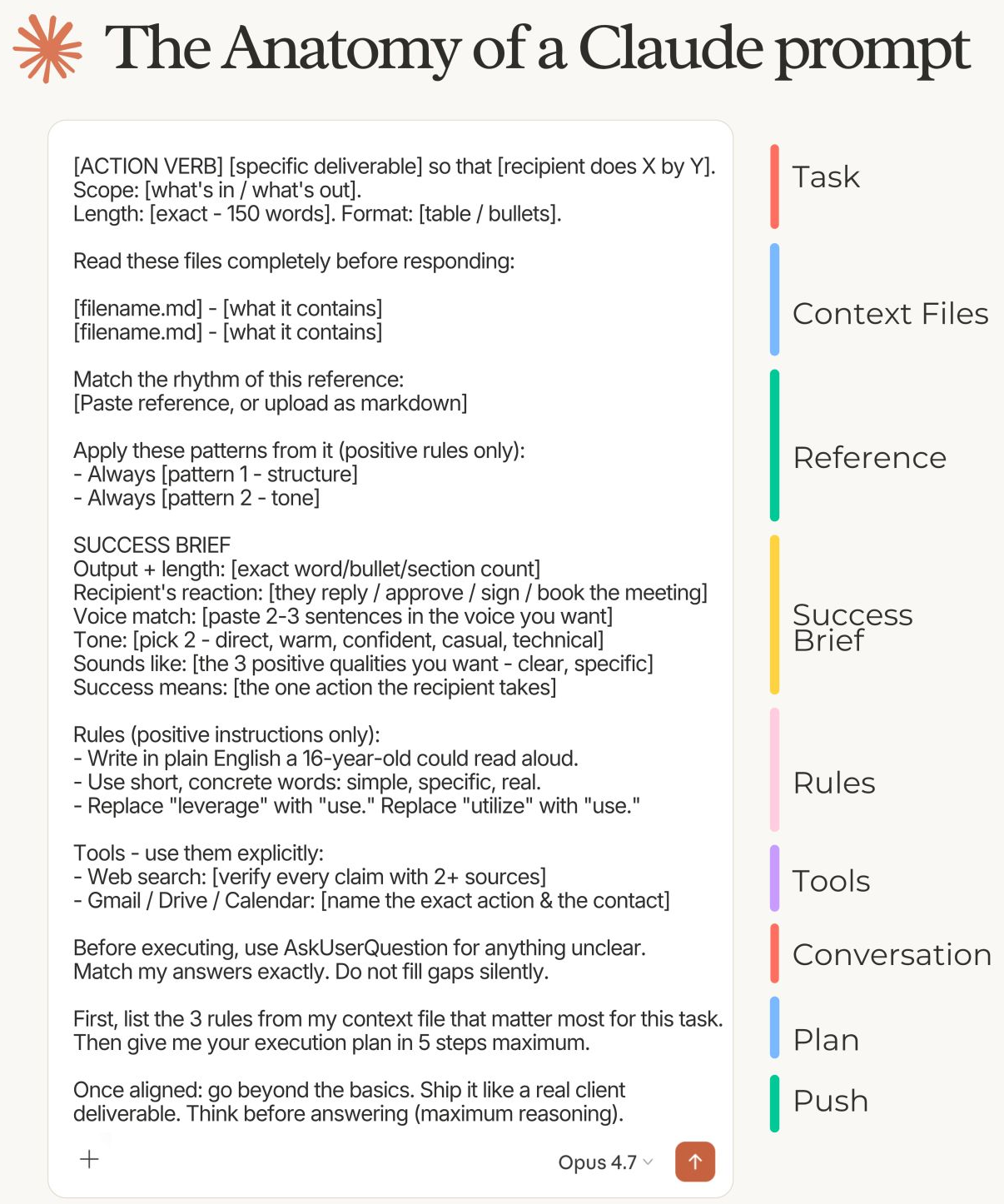
The 3-Tier Decision Matrix
Before composing any specialist delegation, select the tier. Full details and rationale in
.claude/skills/governance/golden-prompt-pattern/SKILL.md — "Quick form vs Full form vs SKIP" section.
| Tier | Parts Used | When |
|---|---|---|
| Full (9-part) | All 9 parts | Default for every new-scope specialist delegation, plan files, daily plans |
| Quick (3-part) | Parts 1 + 2 + 5 | Re-runs of same scope · READONLY queries with profiles · Trivial fixes <10 LOC |
| Skip (0-part) | No injection | Agile ceremonies · READONLY raw-data queries with user-provided profiles |
Decision rule: When in doubt, use Full. Quick is an optimization for already-established context. Skip applies only to ceremonies and pre-authorized READONLY work — see the full SKIP Tier Rationale below.
The 9 Parts (Summary)
Each part serves a specific model-behavior function. The complete per-part why,
what_if_missing, and business_value table lives in the skill SSOT at
.claude/skills/governance/golden-prompt-pattern/SKILL.md.
| Part | Positive Instruction | Purpose |
|---|---|---|
| 1. Task | Action verb + deliverable + recipient + scope boundary + length + format | Eliminates vague scope; named bounded outputs = no rework |
| 2. Context Files | List files with one-sentence purpose each | File = brain; avoids prompt-bloat and stale assumptions |
| 3. Reference | Match this reference. Apply: Always [pattern] | Exemplar anchors output shape; consistent voice across 40 agents |
| 4. Brief | Output + length + recipient reaction + voice + tone + sounds-like + success | Positive brief sticks; describes success as a reader action |
| 5. Rules | Every rule rephrased as TO-DO; include self-policing instruction | TO-DO framing activates self-correction loop |
| 6. Tools | Name which tools are allowed; include file-lock for Edit/Write | Model defaults to tool restraint without explicit permission |
| 7. Conversation | Ask clarifying questions before executing (new-scope only) | Prevents HIDDEN_ASSUMPTION; gates for Tier 1 agents |
| 8. Plan | State 3 most relevant rules + 5-step execution plan | Alignment before spend; PDCA loop at unit level |
| 9. Push | Maximum reasoning; name the highest-value axis | Depth on purpose; generic "go beyond" activates depth; naming focuses it |
Part 7: Two-Tier Clarification Rule
Part 7 behavior differs by agent tier — see
.claude/rules/engineering/coding-discipline.md Rule 1:
- Tier 1 agents (product-owner, cloud-architect, developer-experience-engineer, qa-engineer,
infrastructure-engineer, python-engineer): use
AskUserQuestion(max 5 questions) when ambiguous. - Tier 2 agents (all other specialists): surface ambiguity as
BLOCKED: ambiguity in [scope]and escalate to the invoking command — never callAskUserQuestiondirectly (it would surface to the wrong layer).
SKIP Tier Rationale
Injecting the 9-part form into agile ceremonies or pre-authorized READONLY queries triggers five
tracked anti-patterns. Full evidence in
.claude/skills/governance/golden-prompt-pattern/SKILL.md — SKIP Tier Rationale section.
Why ceremonies are exempt
From adlc-governance.md (verbatim):
"These are the management tools that help HITL decide what to coordinate next — blocking them behind coordination creates an infinite loop."
Ceremony commands (/ceremony:standup, /ceremony:retro, /ceremony:plan, /ceremony:review,
/metrics:update-dora) are READ + AGGREGATE + DISPLAY operations. Injecting the 9-part form
also consumes ~11% of the 20% framework coordination cap per session
(operational-efficiency.md Rule 1).
| Anti-Pattern | How Ceremony Injection Triggers It |
|---|---|
READONLY_HITL_HANDOFF | Ceremony is pre-authorized; asking HITL = handing off authorized work |
LAZY_DEFERRAL | Blocking behind coordination without a hook-denial justification |
SCORING_THEATER | Ceremony already aggregates data; no coordination gate needed |
DOC_AS_DELIVERABLE | Prompt injection turns ceremony into documentation exercise |
JQ_HANDOFF_TO_HITL | Ceremony runs jq/SQL reads autonomously |
Why READONLY raw-data queries are exempt
When user-provided profiles are active ($AWS_OPERATIONS_PROFILE, $AWS_BILLING_PROFILE,
$AZURE_SUBSCRIPTION_ID), the profile itself is the authorization
(.claude/rules/governance/principle-i-acceptable-agency.md — READONLY exemption).
Injecting Full or Quick form adds no governance value and activates LAZY_DEFERRAL +
READONLY_HITL_HANDOFF.
C6: Auth Recovery (Step 0.5)
After scope is confirmed (Step 0) and before the first edit (Step 1), run auth pre-flight.
Full detection commands: finops/auth-preflight skill v1.1.0.
| Failure Signal | Recovery |
|---|---|
| AWS SSO expired | aws sso login --profile $AWS_BILLING_PROFILE |
| Azure CLI unauthenticated | az login --tenant $AZURE_TENANT_ID |
| MCP server disconnected | Restart Claude Code session |
Anti-Patterns
| Anti-Pattern | Violation | Prevention |
|---|---|---|
| Skipping Part 7 when scope is genuinely ambiguous | FALSE_AS_IS_STATE | Always confirm scope for new-scope delegations |
| Injecting Full form into ceremony commands | READONLY_HITL_HANDOFF + infinite loop | Apply Skip tier; cite adlc-governance.md |
| Injecting any form into READONLY queries with profiles | LAZY_DEFERRAL + READONLY_HITL_HANDOFF | Apply Skip tier; profiles = pre-authorization |
| Using "DO NOT" framing in injected specialist prompts | 4.7 fixation on avoided behavior | Reframe as "Always [positive action]" |
| Injecting Quick form for new-scope delegation | Silent capability loss | Use Full 9-part for every new scope |
| Forking skill content into this page | Two SSOTs = drift | This page links, never duplicates |
Canonical References
| Source | Purpose |
|---|---|
.claude/skills/governance/golden-prompt-pattern/SKILL.md v2.1.0 | SSOT — 9-part anatomy, Quick/Full/SKIP matrix, per-part table, Step 0, C6 |
.claude/rules/engineering/coding-discipline.md Rule 9 | Enforcement rule — 3-tier decision + pointer to skill |
code.claude.com/docs/en/sub-agents | Subagent context isolation — why prompt injection is the delivery mechanism |
code.claude.com/docs/en/memory | CLAUDE.md is advisory, not enforcement — supports rules-layer choice |
.claude/rules/governance/adlc-governance.md | Ceremony SKIP citation (L78-83 infinite-loop quote) |
.claude/rules/governance/principle-i-acceptable-agency.md | READONLY exemption — profiles = pre-authorization |
Owner: ADLC Governance Team | Skill version: v2.1.0 | Page type: citing mirror (non-canonical)