The CMDB-to-CSDM Gap: Why Most IT Inventories Never Deliver Business Intelligence

| Who | ANZ Cloud Platform Team + C-Suite Stakeholders |
| What | CSDM-aligned service map linking infrastructure to business capability |
| When | CC-S1 Bootstrap phase (May–June 2026) |
| Where | AWS accounts → ServiceNow CSDM 5 compatibility target |
| Why | Every unowned resource is a risk; every unmapped cost is invisible to the CFO |
| How | Discovery via runbooks CLI → CI contracts → CSDM model → Confluence + Backstage publish |
Why: Every unowned cloud resource is an invisible risk — infrastructure without a business owner cannot be costed, governed, or audited.
What if missing: Orphaned resources accumulate silently; cost overruns become visible only at CFO reporting time, not at provisioning time.
Business value: Service-map completeness ≥95% means every dollar of cloud spend links to a named owner and business capability — enabling real-time cost allocation and APRA CPS 234 audit readiness.
Critical thinking: This approach requires engineering discipline to maintain CI contracts as infrastructure changes — without automation hooks, the map drifts. CC-S2 ADLC automation hooks address this.
Act 1: The Problem
Your IT team has catalogued 50,000 infrastructure items. Your CFO cannot quantify cloud outage impact to the business. These facts are connected.
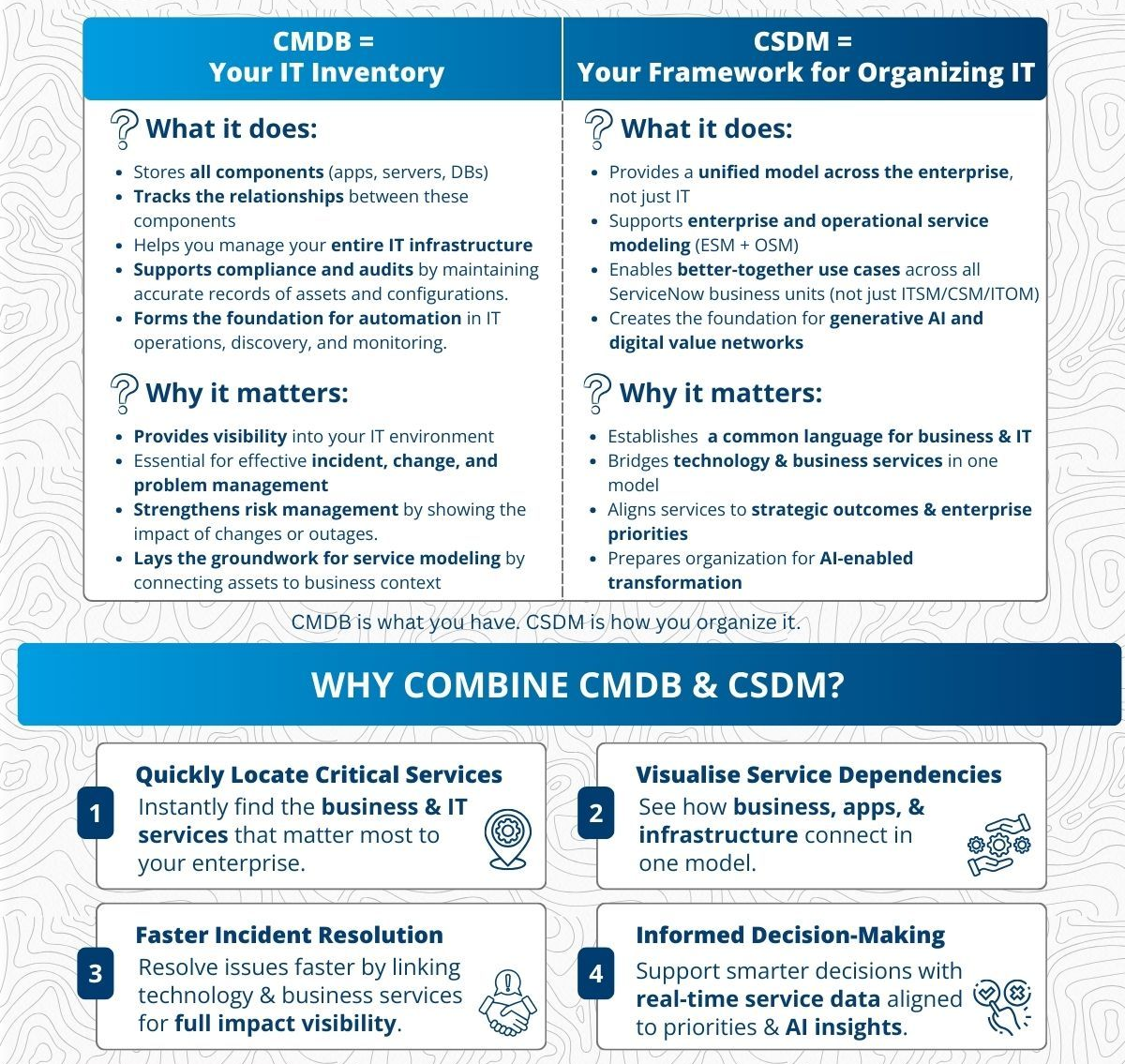
A CMDB is a spreadsheet of what you own: EC2, databases, load balancers, applications. A CSDM is the pivot table showing which infrastructure serves which business capability. Most enterprises have the spreadsheet. Few build the pivot tables. The data sits unused.
- No service-to-infrastructure hierarchy → cannot answer "what breaks the business?"
- Data staleness → no real-time governance
- Ownership gaps → no single accountability point
- Manual propagation → no automatic rollup
Act 2: The Framework
CSDM is a five-level hierarchy rolling data upward at each level:
- Visual Hierarchy
- Plain English
- Business Capability — Loan Origination
- Business Service — Premium Origination (SLA-backed)
- Technical Service — Loan API + Database
- Application Service — API + PostgreSQL
- Configuration Item — EC2, RDS, ALB, Security Groups
Change an EC2 instance (level 5). All upstream levels shift in real time—the cascade a CIO cares about.
Act 3: Why Board-Level Care
For a CIO, the question is not "what is in the CMDB?" It is whether the business absorbs failure impact. Think of CMDB as the inventory sheet; CSDM is the business impact map.
- Can you show me which business services are at risk if AWS Account X is compromised?
- Who owns each service end-to-end, and can you prove it with data?
If the answer is "the CMDB team will check," the gap is open. Risk lives there.
Act 4: What Good Looks Like
An energy retailer mapped 8,400 items to 5 services in one sprint. Six data sources reconciled across cloud, monitoring, ITSM. Most aligned cleanly; some surfaced as discrepancies; a few needed ownership review.
The hierarchy handled batch and real-time updates. Ownership held steady. It scales.
The runbooks CLI covers discovery through validation in five commands:
runbooks inventory discover --profile $AWS_OPERATIONS_PROFILE
runbooks cmdb model generate --source inventory.csv
runbooks cmdb identify-gaps --threshold 0.80
runbooks cmdb reconcile --target servicenow --dry-run
runbooks cmdb health --dry-run
Every command runs with --dry-run first (no writes). Review the output. Rerun without --dry-run when ready. READONLY profiles prevent accidental mutations. Agents prepare, humans decide.
Act 5: CxO Decision Frame
Ask your IT team these two questions THIS WEEK:
- Risk Visibility: Which business services are at risk if AWS Account X is compromised?
- Ownership Clarity: Who owns each service end-to-end, and can you prove it?
If the answer is delay or "the CMDB team will check," the gap is open. Command Center closes it.